A lot of people have been asking my thoughts on the IKEA Alpstuga and it’s easy to see why - it’s a $30 air quality monitor that somehow manages to include both PM and CO2 sensors in a very low cost device. Of course, that has raised some questions as to how accurate and performant the device actually is.
While I haven’t been able to get my hands on one yet (they’re still not released here), there is more and more content coming out about these devices and we now have clarification on the specifications and the sensor used. A few days ago, a reader reached out to me (thank you!) and shared a couple of teardowns:
This sensor usually costs around $30 by itself, so being able to fit it in a complete device that costs only $30 is quite an achievement. Of course, with the scale of IKEA they will get far lower pricing, but it’s still impressive to see such a low cost device that uses a decent sensor. It also means that there’s very likely to be any competition at this price point… Perhaps unless Amazon decides to update its air quality monitor.
While it’s hard to tell for certain, I believe that the SEN63C uses Sensirions’ new thermal conductivity technology for the CO2 sensor (the same used in the STCC4). This is still uncertain, however. The PM sensor is also a new design called the SPS6X. Again, relatively little is out there about this sensor at the moment.
Looking forward to seeing and learning more about these sensors in the future!
I remember seeing on Reddit someone talking about the sensor who said they were on the team that made it. I bought one of these Alpstuga now and as soon as I have replaced the battery in my A-37 I will compare the values for accuracy. So far I can already tell that this one is less precise than the Cubic sensor in the A-37 but in the end most of the time one only needs to know the lower bound (to know when one is done airing) and a rough value to not fall asleep in disease safe and not be too long in risky environments
That would be an awesome comparison to see! I am hoping to have my own Alpstuga later this month, so hopefully I can do some comparisons then too.
Apparently there is an issue with the STCC4 that causes it to read too high if the conditions change greatly (for example, going outdoors and then getting into a car), but this shouldn’t be such an issue on an indoor/static monitor.
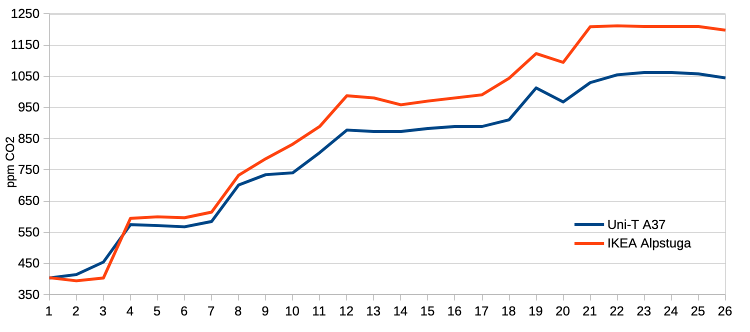
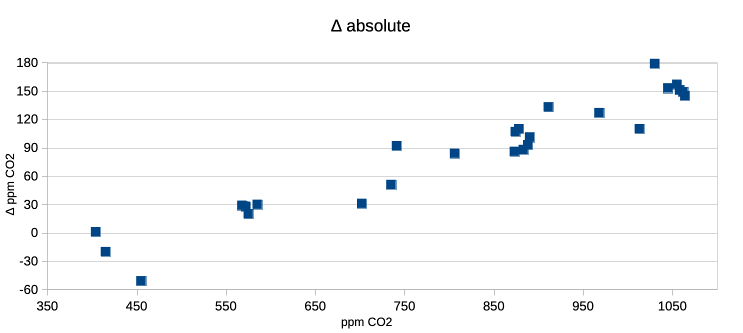
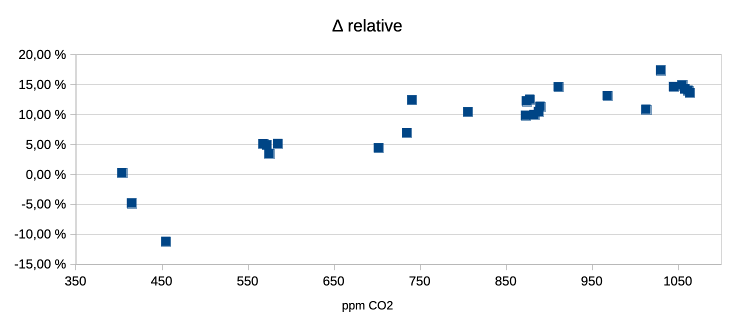
We can tell that the Alpstuga measures mostly higher values than the Uni-T A37 which seems to show some kind of average over 2 minutes but updates it very frequently on the display, while the Alpstuga seems to measure a more volatile direct value but updates it less frequently on the display
Unfortunately I ran out of battery for the A37 and I cannot charge it at the moment as the micro USB port is broken (I will solder a USB-C one on someday)
Hmm, somehow I cannot edit that post today. Well, the first few time entries in the table should be 13:mm:ss of course. No idea how they changed, maybe libreoffice calc?
– addendum –
I figured out how to edit the table. One has to hover the table itself, it has its own edit button
I migrated the forum to a new URL yesterday so it may have caused some issues.
Overall, the graphs look very similar and I would guess that the systematic difference is largely due to different calibrations/slightly different reading times.
I think this new sensor is quite good for indoor/static uses. It seems to have some issues with portable devices that can experience rapid and vast concentration changes, but it’s great that it’s enabled more (seemingly) accurate low-cost air quality monitors.