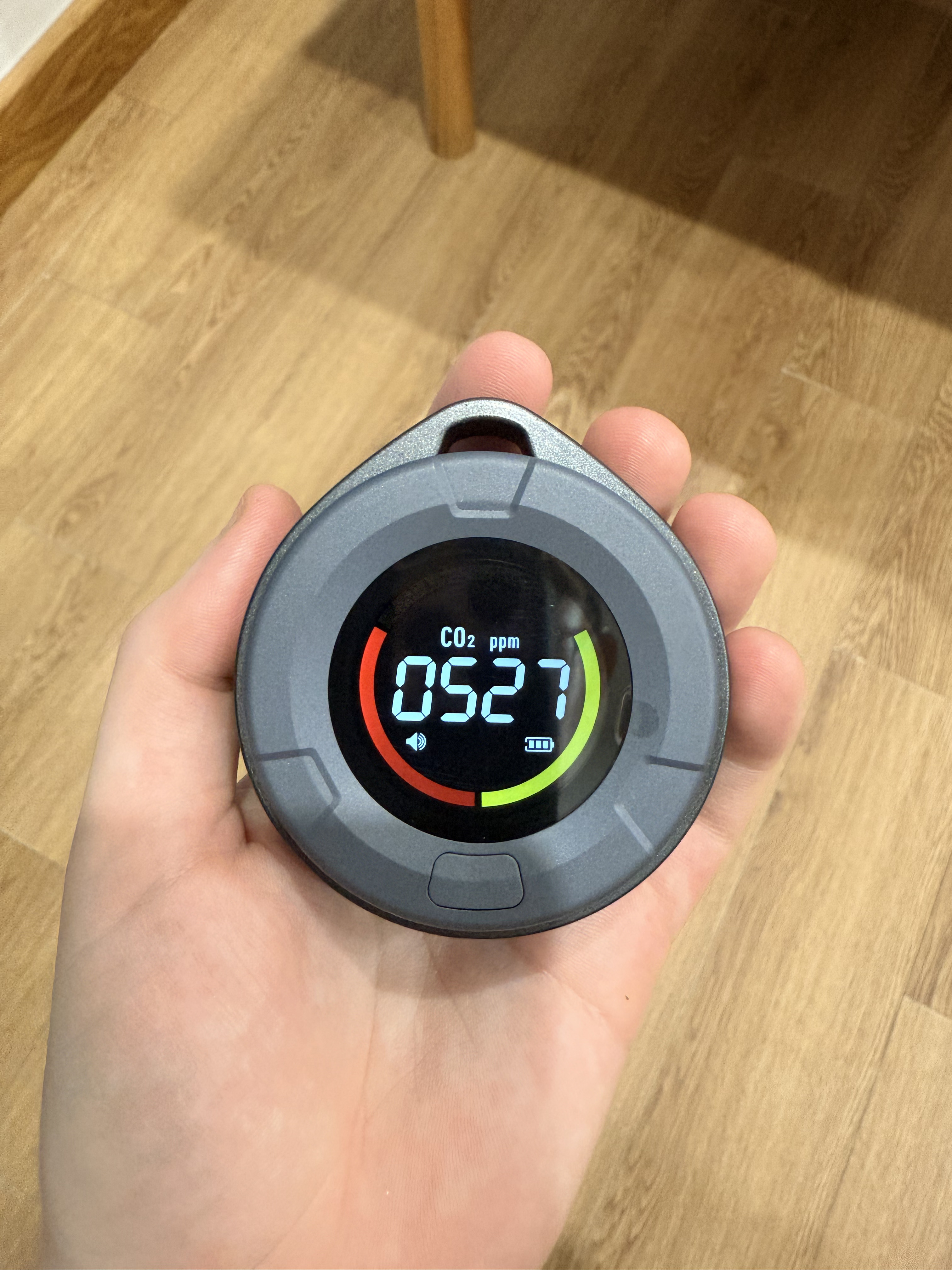
INKBIRD PTH-10C - A Good Affordable CO2 Monitor?

For the past few years, I’ve recommended the Vitalight Mini CO2 Detector as the most affordable carbon dioxide monitor. While there are some cheaper options out there, this was the lowest cost device that I could recommend due to the fact that - despite having many flaws - it still uses a genuine NDIR sensor that has proven to be quite accurate. However, it is far from perfect and I’ve heard from quite a few users that durability is not great. While my monitor still works, I’ve been looking for some other low cost devices that are accurate enough that I can recommend them.

Recently, I began to hear a lot about the INKBIRD PTH-10C, a very low-cost CO2 sensor that I thought deserved a deeper look. I’ve had the device for a couple of weeks now and I’ve had some time to do some initial testing with the device. While I will have more thoughts to share in an upcoming full review, I thought I would share them here as many people appear to be interested in this device. Let’s dive in!

For reference, here is my review of the Vitalight, which explains some of my issues with the device as well as the positives.

Vitalight Mini CO2 Detector Review:

The first appeal of both of these devices is the price. Both are very low cost, and they offer comparable prices depending on where you buy them.

Vitalight Mini CO2 Detector - usually around $37, but can be found as low as $25.

INKBIRD PTH-10C - $39 (but I got mine for around $32 in Vietnam).

Both of these devices are in the lowest cost category that I would consider when it comes to CO2 monitors. Any lower than this, and you’re likely looking at devices that use inaccurate sensors (not NDIR) and incorrectly report carbon dioxide concentrations. For this reason, I’m always very hesitant to recommend any ultra low cost monitors unless I’ve first had a chance to test them myself.

Does the INKBIRD PTH-10C Use NDIR?

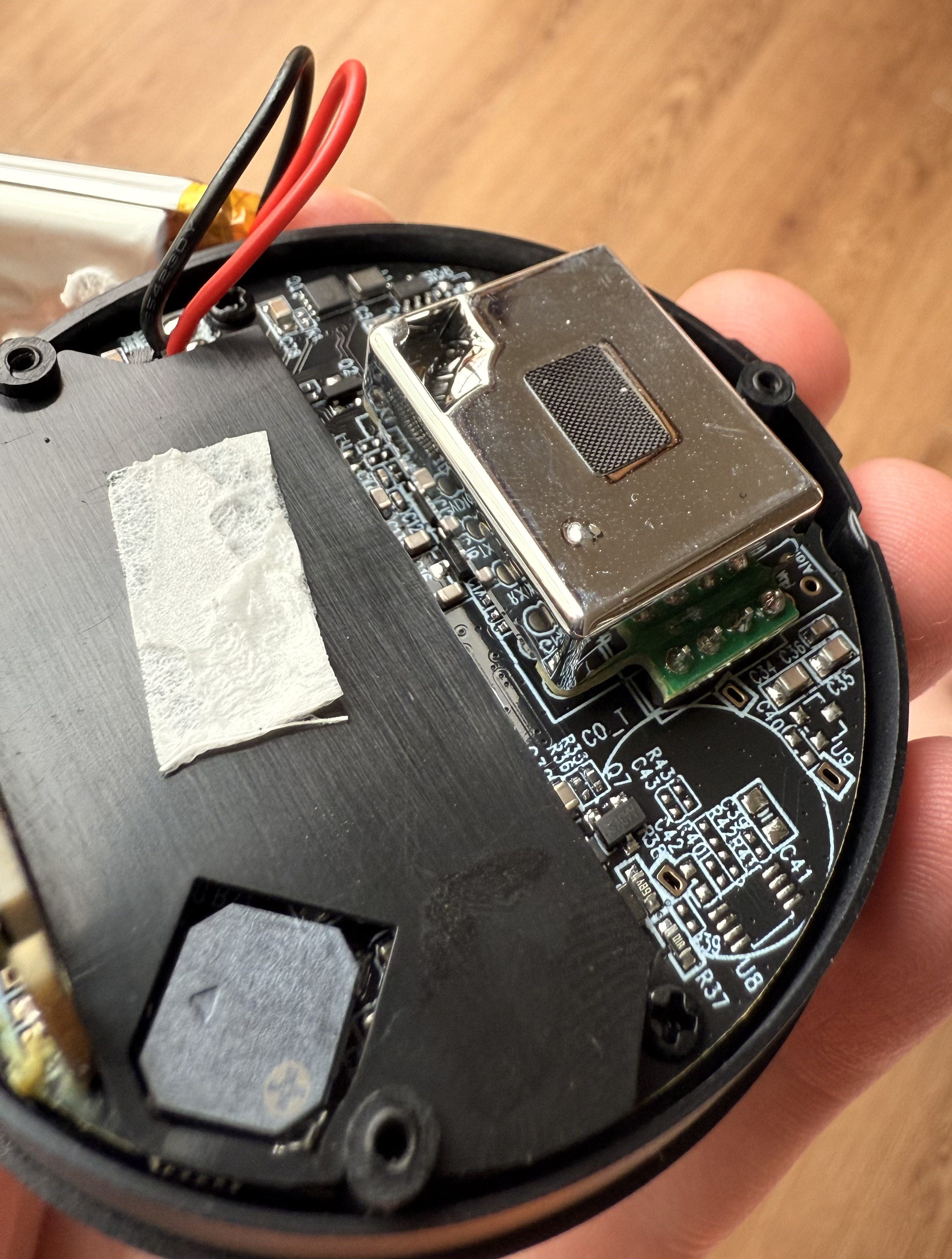
Yes! This is the first thing I look for in any low-cost CO2 monitor, and I’m glad to say that the PTH-10C does indeed use an NDIR sensor. While I’ve been unable to find the brand or model number of this sensor, having an NDIR sensor at least means the device has the potential to be accurate. If, for example, the device has a metal oxide semiconductor (MOS) sensor, I would instantly discount it as not being able to provide accurate readings.

So, is the sensor accurate? Well, I haven’t yet had a chance to thoroughly test this, but it does appear to track quite closely with my other devices such as the Aranet4 Home and AirValent CO2 monitor. While I want to spend more time with the device before coming to a conclusion here, my first impressions are positive in regards to accuracy.

INKBIRD PTH-10C vs Vitalight Mini CO2 Detector

Similarly to the Vitalight, the INKBIRD is a ‘dumb’ CO2 monitor that does not offer any form of connectivity, data exporting, or other advanced features. In this price range, this is expected, but it is important to keep in mind.

Typically, the PTH-10C is a bit pricier, so is the extra cost worth it? I think it may well be for the following reasons:

  • The PTH-10C feels better built and I would guess it is more durable. I can’t guarantee this as I’ve only had mine for a few weeks, but I believe it is more durable than the Mini CO2 Detector.
  • It has significantly better battery life.
  • Has adjustable alarm thresholds.
  • Allows for manual toggling of ABC (automatic baseline calibration).
  • Has a better screen that is more easily visible in bright areas.
So far, I’ve had quite positive experiences with this device and I think it could be a good choice - as long as you’re aware of its limitations. I will continue to share my thoughts here as I work on my full review.

As always, please feel free to ask if you have any questions!
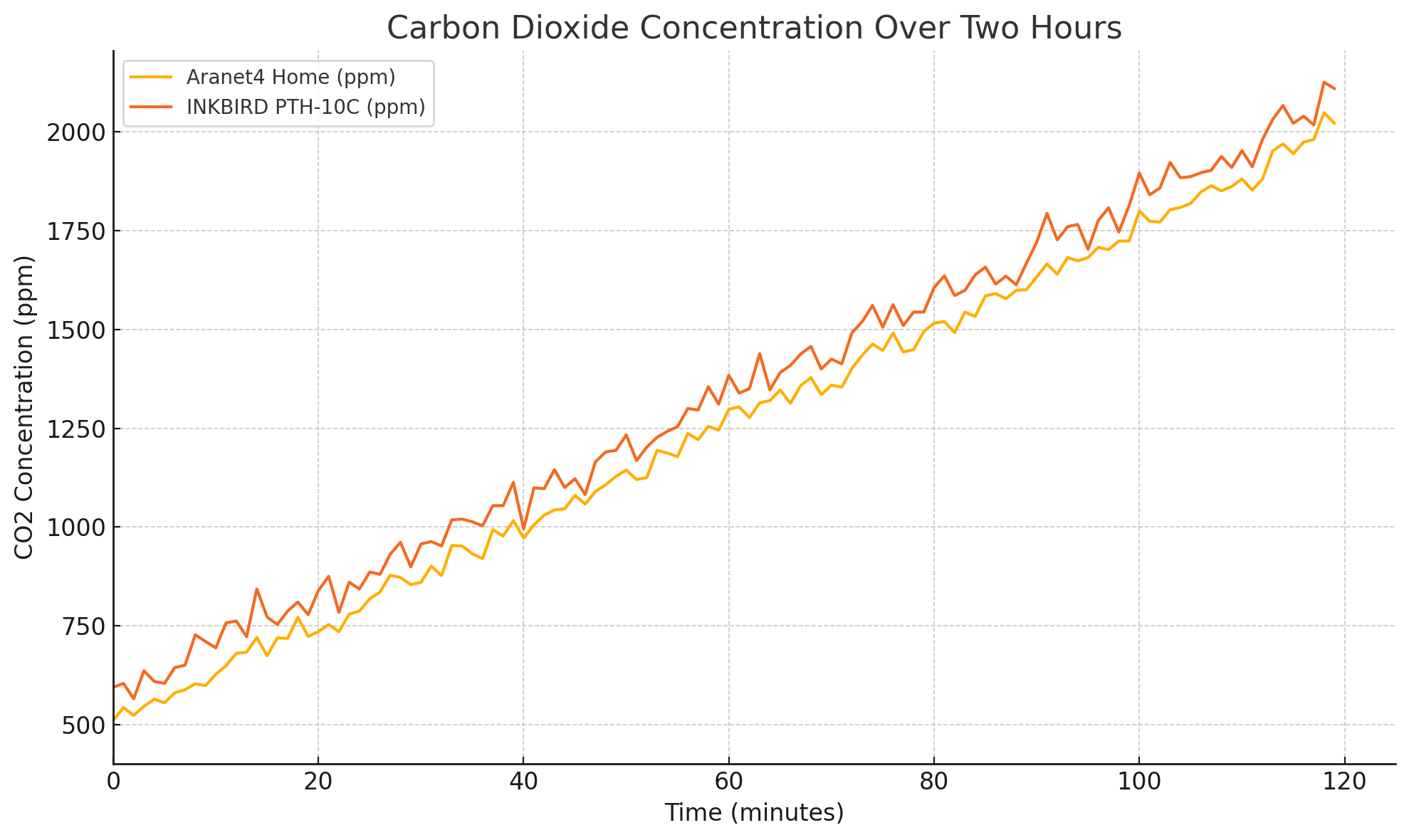
My full review will be done soon, but so far this device has proven to be quite accurate. Below are the results from a test I ran over two hours comparing the readings to my Aranet4 Home (both were calibrated in the same conditions and at the same time).

I’ve completed my full review and you can find it here:

Thanks for sharing this, Ethan. I’ve actually been using the INKBIRD PTH-10C for a little while now, and your experience mirrors mine in many ways. I used the Vitalight Mini CO2 Detector before, and while it worked okay, I wasn’t too sure about its long-term durability. The INKBIRD feels more solid and well-built. I especially appreciate the clearer screen and the ability to toggle ABC manually that’s something I didn’t even realize would be so useful until I started learning more about CO2 monitoring. Battery life has also been impressive so far. I got into air quality monitoring after reading up on the topic through PrimoAire. I’ve used a couple of their products as well, which helped me understand how CO2 levels can really impact things like sleep and focus. That’s what got me to try a few different monitors, and so far, it also seems like a good, affordable choice.

Hi @Lisandra,

It’s great to hear you’ve had similar experiences! How long have you had your device for, and do you often take it out and about with you?

It’s hard to draw conclusions from using the device for only a couple of months, but it certainly feels like a solid and well-built device (especially when compared to the Vitalight). This, combined with the battery improvements and calibration options, leads me to think I will change my ‘low cost’ recommendation in this article: 11 Best Carbon Dioxide Monitors - What You Need to Know about CO2 Monitoring (I just didn’t want to be too hasty in case I ran into issues with the device after the initial review).

Hi Ethan,
Thanks for the thoughtful reply! I’ve had the INKBIRD PTH-10C for just over three months now. I mainly use it at home to monitor air quality in my bedroom and workspace, but I’ve taken it with me on a few short trips too.
That said, I’ve actually started using a few devices from PrimoAire more recently, and I’m really impressed. Their indoor air quality monitors and smartplugs integrate easily with my setup and give me a more complete picture of overall IAQ.

I totally get your hesitation about updating recommendations too quickly. I had similar concerns early on, especially after using the Vitalight, which didn’t feel as durable in the long run. But so far, the PrimoAire have been reliable.

I have an experience with mirrors @Lisandra.

I first purchased a Vitalight Mini back in 2023, and the device totally gave up after 3-4 months. While it was an affordable device, I was quite dissapointed that it stopped working so quickly. I always took care of it, and as far as I can tell, it didn’t stop working due to mistreatment of physical damage.

I still didn’t want to take the plunge on an Aranet, so I looked for another device to try and came across the INKBIRD one. I purchased it in early 2024, and until today, it’s still going strongly! I really didn’t expect it to last this long based on my experience with the Vitalight, but I’ve been pleasantly surprised.

1 Like

Thanks for sharing your experiences @Lisandra and @AirCritic!

Based on what you’ve said (and based on what I’ve heard from others online) it seems like this may well be a better low-cost device than the Vitalight. I think I will need to begin updating my recommendations!

I’ve had one for a little over a year. Bought it as a package with an IAM-T1, and then ended up with another IAM-T1, so I’ve got a pair of devices to compare it to (albeit all from the same manufacturer).

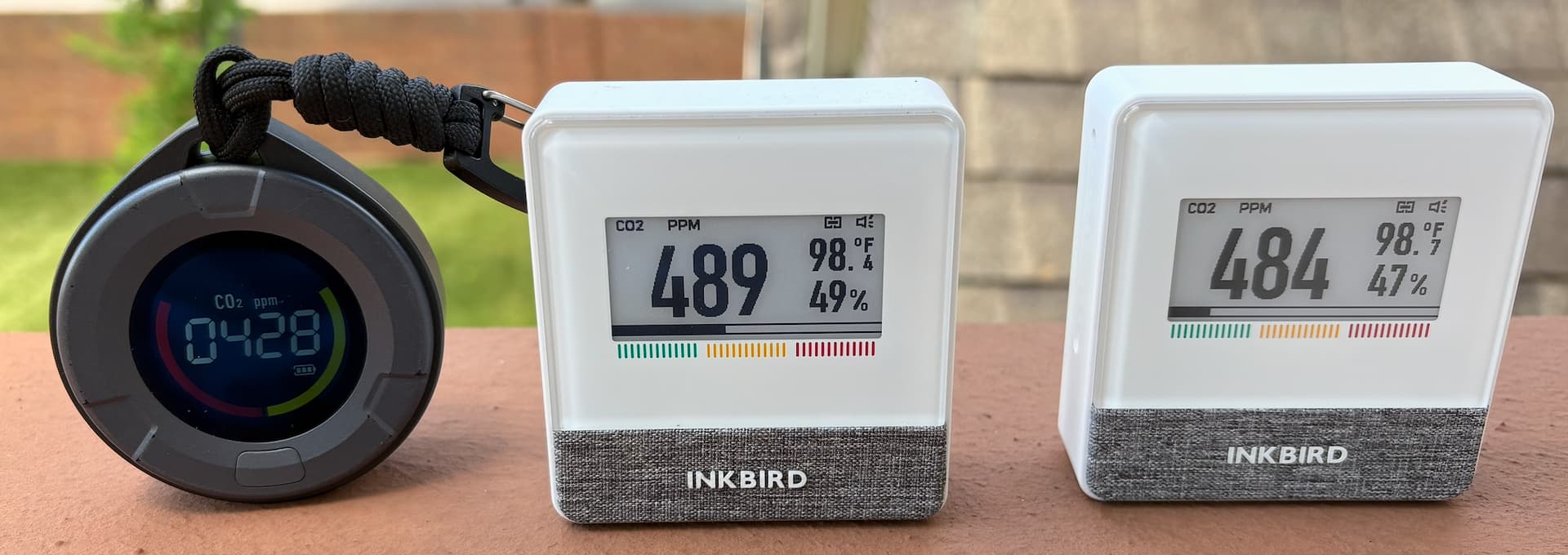
It seems to read about 50-75 units lower than the IAM-T1’s. For a test, I set all three devices outside for half an hour, forced a calibration, and then let them sit for another half hour.

One of the IAM-T1’s had just cycled so the readings are a little bit different. The IAM’s are at 484, the PTH-10C at 428.

I then brought the devices indoors, let them sit in an unoccupied room for 30 minutes. Again, IAM-T1’s are at 660, PTH-10c at 615.

Overall I’m pretty happy with it. Walked into a restaurant where it popped up over 3000 in the time between entering and sitting down, kept my mask on and noped out of there.

Downsides are that it’s a bit on the chunky side and the single-button user interface is difficult to navigate.

1 Like

Hi @Arunw,

This is super interesting, thanks for sharing! I haven’t had a chance to compare to my IAM-T1 yet, but I found that it tended to read a bit higher than the Aranet to which I compared it. I wonder if it’s due to slighty different baseline values (some monitors seem to default to 400, and some to 420). Since both of the IAM-T1’s stay at quite similar values, it seems to be a systematic difference.

Either way, it’s good to see further verification that the PTH-10C is accurate for identifying trends.

I have the same - testing this week with the IAM-T1 & PTH-10C

In the beginning the scores where pretty similar.

Over a couple of days indeed the PHT-10C is standard arround ~70/~90 lower

Also testing the AirValent but this one I’m not satisfied yet in regard to the range and consistency vs the INKBIRD’s

PS Sorry can’t upload pictures in the forum due to new user :slight_smile:

Hi @Goudmans,

Thank you for sharing your experiences! This is quite unusual - I don’t have my IAM-T1 on me to compare against, but I didn’t notice this behaviour compared to my Aranet4.

I wonder if it has something to do with automatic calibration? It almost looks like that could be the cause but it’s hard to tell.

Does the AIRVALENT monitor also read similarly to the IAM-T1?

Hi @Ethan yeah it’s bugging me also :slight_smile:

The T1 now has 666
AirValent now has 568
PTH now has 544

I’m in contact with Inkbird customer support but they mentioned 1 year warranty - I replied back that I bought it in the EU so 2 year warranty is applicable, so now have to wait.

Will also order the AirSpot this weekend to make the setup complete and compare them all.

I hoop to get a more straighter baseline because these numbers just feel to much apart.

I definitely understand this! In saying that, I find it interesting that the AIRVALENT read a much higher value in your previous image, but now the T1 is reading higher. I think this is very likely due to automatic calibrations taking place.

Do you have automatic calibration enabled on the IAM-T1? I can’t remember if it can be disabled on the AIRVALENT.

I returned the AirValent and just received a new IAM-T1 and the AirSpot :slight_smile:
(Really like the size and wristband so far of the Airpost!!)

Left NEW IAM-T1 at 705
Airspot 587
Right OLD IAM-T1 at 732

Will keep track of the values in the coming days and will also do a manual calibration of the AirSpot. None of the devices is on auto calibration by the way.

I hope you like the AirSpot monitor @Goudmans! It’s one of my favourites due to all of the app functionality (I love being able to quickly see the CO2 concentration from my phone’s lock screen).

I definitely think there are still some calibration differences between the devices because both the SCD41 and Sunrise (used in these two monitors) are good sensors.

Personally, I love the keychain attachment for the AirSpot. I don’t actually use it as a keychain, but it’s great to hang on a bag!

Yes I also really like the size and format! I also bought the wristband, which makes it so much easier now to carry around at work, etc.

The overall quality feels good. A bit plastic but lightweight!
Needs to be used over time to see if it’s durable.
Will keep you posted on the long-term results :+1:

Overall, the devices I have tried, I must say the AirValent feels really high-end and premium!
None have matched that feeling - sad that I had to return it, but that’s mostly because of the portability of the device. I really hope they make a hanger or something else to make it more usefull on the go. (On their manual it also says device should not be shaken etc)

1 Like